
Above, morphological rules are described as analogies between word forms: dog is to dogs as cat is to cats and as dish is to dishes. In this case, the analogy applies both to the form of the words and to their meaning: in each pair, the first word means "one of X", while the second "two or more of X", and the difference is always the plural form -s (or -es) affixed to the second word, signaling the key distinction between singular and plural entities.
One of the largest sources of complexity in morphology is that this one-to-one correspondence between meaning and form scarcely applies to every case in the language. In English, there are word form pairs like ox/oxen, goose/geese, and sheep/sheep, where the difference between the singular and the plural is signaled in a way that departs from the regular pattern, or is not signaled at all. Even cases regarded as regular, such as -s, are not so simple; the -s in dogs is not pronounced the same way as the -s in cats; and, in plurals such as dishes, a vowel is added before the -s. These cases, where the same distinction is effected by alternative forms of a "word", constitute allomorphy.
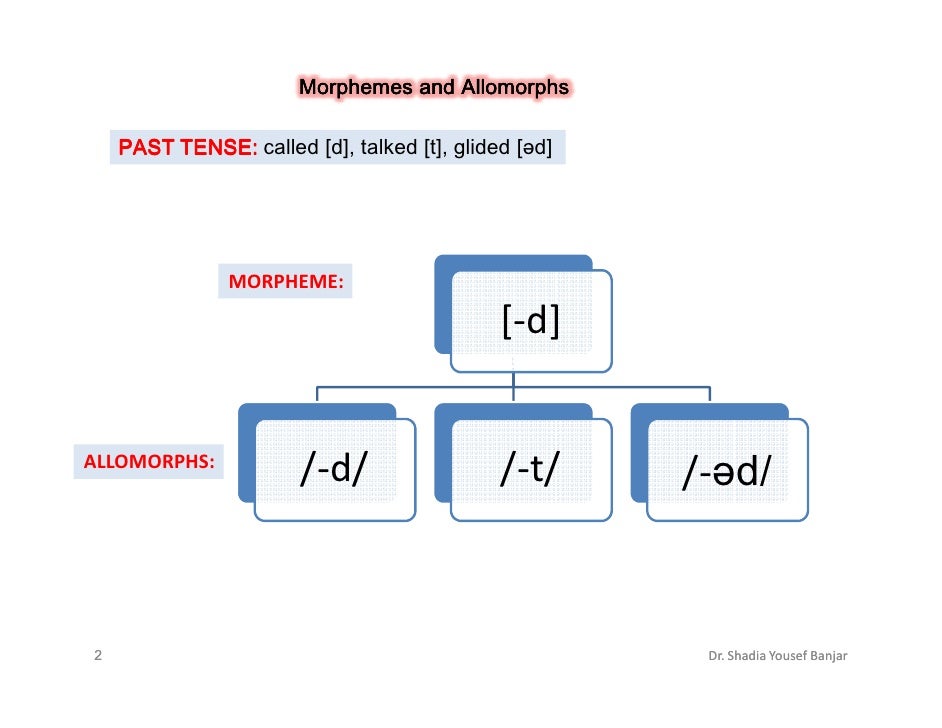
Phonological rules constrain which sounds can appear next to each other in a language, and morphological rules, when applied blindly, would often violate phonological rules, by resulting in sound sequences that are prohibited in the language in question. For example, to form the plural of dish by simply appending an -s to the end of the word would result in the form [dɪʃs], which is not permitted by the phonotactics of English. In order to "rescue" the word, a vowel sound is inserted between the root and the plural marker, and [dɪʃɪz] results. Similar rules apply to the pronunciation of the -s in dogs and cats: it depends on the quality (voiced vs. unvoiced) of the final preceding phoneme.

No comments:
Post a Comment